CEMO campus
Battery safety: Charging, storing and transporting lithium-ion batteries safely
The Basics of Battery Safety

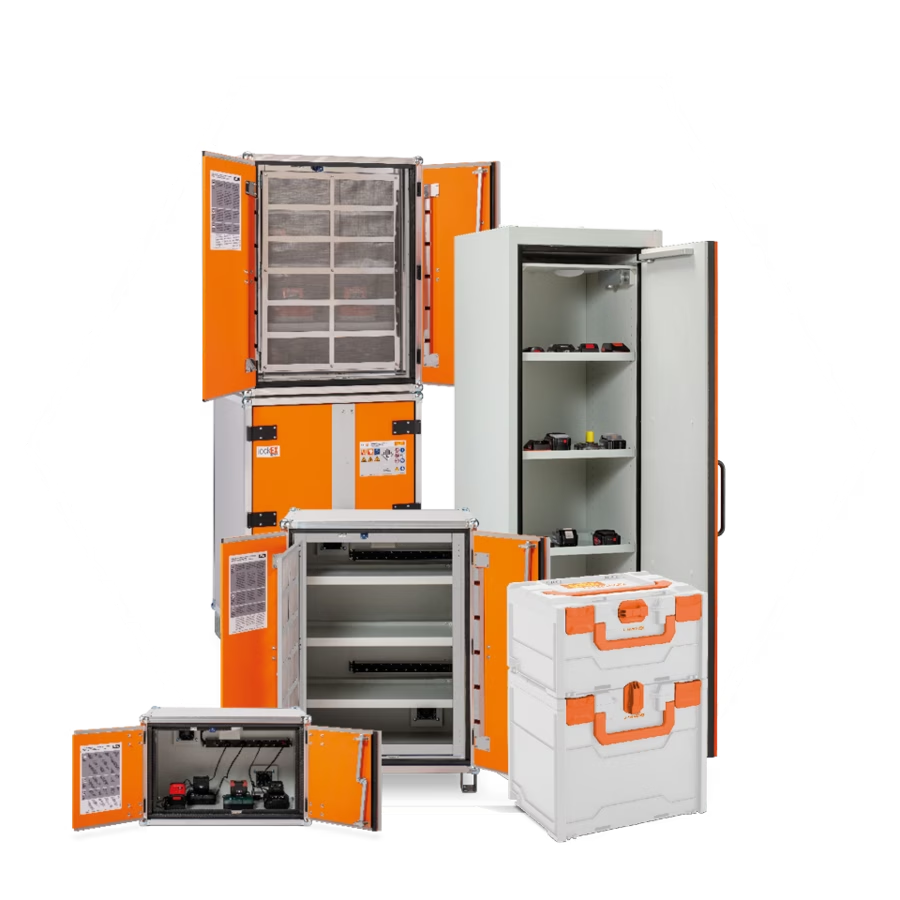
What risks are associated with charging, storing and transporting lithium-ion batteries? What requirements apply to battery storage cabinets and battery charging cabinets? What is the significance of the maximum storage capacity in kWh, explosion protection and current testing standards such as VDMA Standard Sheet 24994? On the CEMO Campus, you will find the relevant fundamentals for the safe handling of lithium-ion batteries – from risk analysis, through fire prevention and explosion protection, to legal requirements and specifically designed safety solutions.
Compact energy storage systems
Underestimated risks
Lithium-ion batteries are compact energy storage devices and have become an indispensable part of everyday operations. However, the risks they pose are often underestimated. Overcharging, damage or faults can lead to thermal runaway, a fire or an explosion. The aim of battery safety is to protect people, buildings and business operations from the consequences and to comply with legal requirements.
| Protecting people | Protecting buildings | Protecting processes | Protecting the environment |
|
|
|
|
An overview of regulations and rules
Abbreviation |
Regulation |
Implications for battery safety |
| VDMA Standard Sheet 24994:2024-08 | Test requirements for fireproof storage and charging cabinets for lithium-ion batteries. | Current state of the art for lithium-ion battery charging cabinets. Specifies that the cabinet must withstand defined temperatures and explosive forces. Sets clear limits on storage capacity in kWh. |
| DIN EN 14470-1:2023 | Product standard for safety cabinets for flammable liquids | Defines safety cabinets for flammable liquids and fire resistance classes Type 30, 60 and 90. Is also used as a supplementary reference for battery cabinets. |
| GS Test Principle EK5/AK4 22-01 | Principles for the testing and certification of safety cabinets for lithium-ion batteries | Testing principle for safety cabinets for lithium-ion batteries. Tests, amongst other things, fireproof|fire rating from the inside out and from the outside in. |
| TÜV NORD CERT Test Programme | Principle for the testing and certification of storage containers for lithium-ion batteries | Testing principle for lithium-ion battery storage units (e.g. cabinets or transport containers). Tests the test specimen, amongst other things, by means of an explosion test and a real-world battery fire test. |
| VdS 3103 (as at September 2019) | Safety rules and risk analysis | Regulates the transport of lithium-ion batteries (UN 3480) and lithium metal batteries (UN 3090). |
| VdS 6159 (as at November 2026) | Safety rules and risk analysis | Guidance on the safe operation of hand-held lithium-ion rechargeable batteries, including specific measures for damage prevention. |
| ADR 2025 relating to UN 3480 and UN 3481 | Dangerous goods regulations for the transport of lithium-ion batteries | The ADR regulates the carriage of dangerous goods and activities directly related thereto, but does not generally cover the stationary storage of lithium-ion batteries. |
Hazardous materials: lithium-ion battery
Fire risk: One in every 15 fires is caused by lithium-ion batteries!
According to the Institute for Loss Prevention and Loss Research of Public Insurers (IFS), one in every 15 fires is caused by lithium-ion batteries. Cabinets used exclusively to store rechargeable batteries whilst they are charging, and which are kept only partially full, limit the fire load and improve operational safety.
Typical causes of battery fires
- Overcharging
- Deep discharge
- Overheating
- Mechanical damage
- Faults in the charge controller
- Wear and tear
Battery fires are most likely to occur in the following situations:
Source: IFS, ‘Fire Risk from Lithium-ion Batteries’, Issue 27, 03/2024
Practical tip: 5-step checklist
Step |
Test |
Procedure |
| 1 | Visual inspection | Check the batteries for physical damage. |
| 2 | Temperature check | Feel or measure the temperature of the battery. |
| 3 | Capacity test | Measure how much energy the battery can still store. |
| 4 | Count the charge cycles | Check how many times the battery has already been charged and discharged. |
| 5 | Check functions | Check the status indicators and warning messages from the battery management system. |
Warning signs: How to spot the battery risk

Can no longer be charged
can no longer be charged

does not release any energy

Damage to the mount (slide)

Heat generation at rest

Heat generation during use >60°C

Housing deformed

Damaged casing

Fluid is leaking

pungent smell

Smoke, signs of scorching
Note: If a battery shows any of these signs, take it out of service immediately and store it separately from other batteries.
Safe charging, storage and transport
Important information regarding lithium-ion batteries
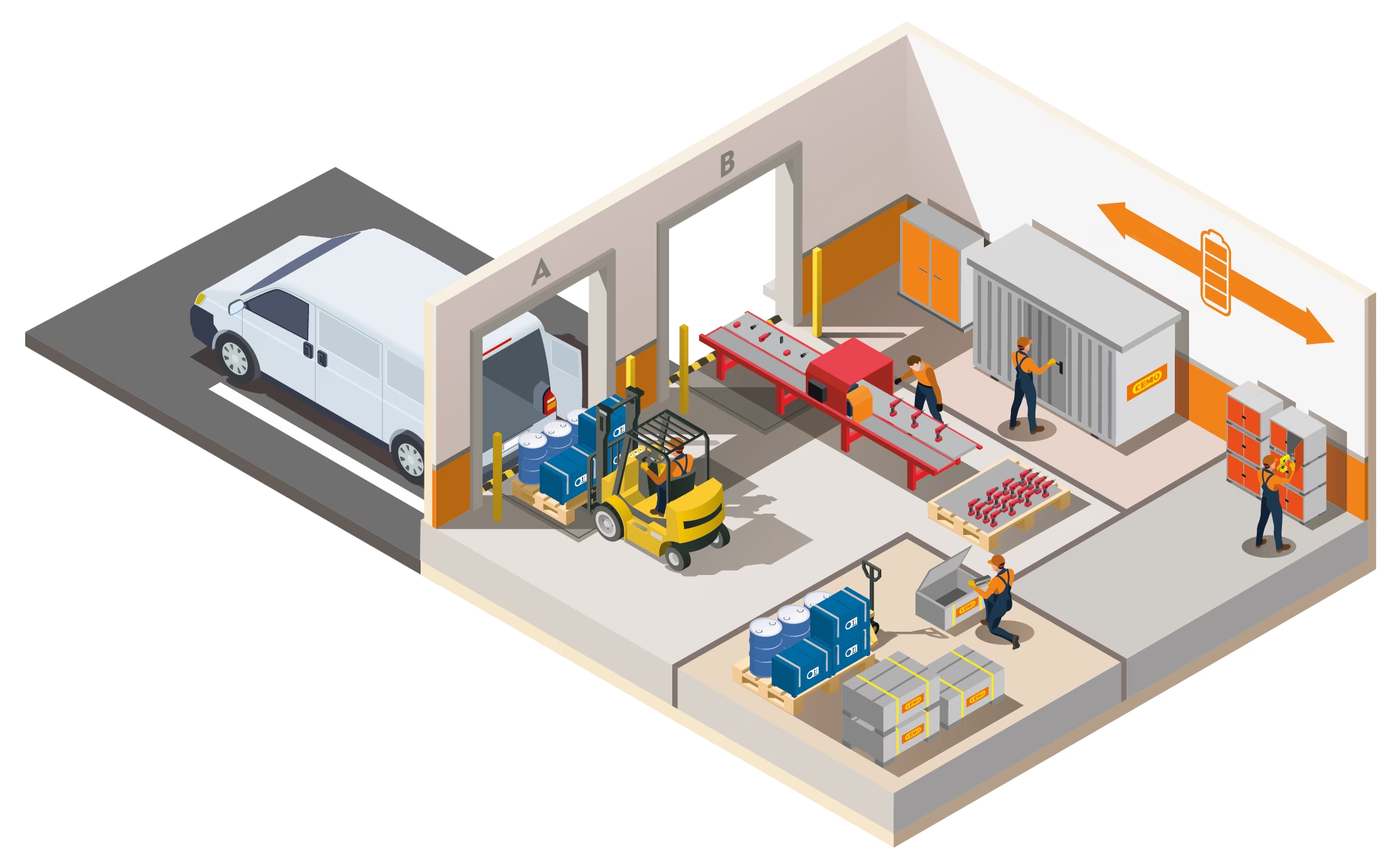
Storing lithium-ion batteries safely
Significance of the maximum storage capacity (kWh)
The maximum storage capacity of a safety cabinet, expressed in kilowatt-hours (kWh), is a key criterion for the safe storage of lithium-ion batteries. It describes the total amount of energy that may be safely stored in the cabinet. If this limit is exceeded, the risk of thermal incidents such as overheating, fire or explosion increases significantly.
Calculation of kWh power
Energy (kWh) = Voltage (V) × Capacity (Ah) ÷ 1,000
This requires two values, which are usually marked directly on the battery:
- Nominal voltage (V), e.g. 18 V
- Capacity (Ah), e.g. 5.0 Ah
Example: 18 V × 5.0 Ah ÷ 1,000 = 0.09 kWh (90 Wh)
Standardised battery fire testing in a safety cabinet is now state of the art
New testing standards set the benchmark
Standardised battery fire testing in a safety cabinet is now state of the art
VdS 3103
Safety rules and risk analysis relating to the provision of lithium batteries in production and storage areas.
EN 14470-1: Fire resistance classes
The EN 14470-1 standard relates to fire prevention storage cabinets for the storage of flammable liquids. This European standard specifies the performance requirements for such cabinets to ensure that, in the event of a fire, they can withstand the fire for a specified period of time and protect their contents. Cabinets are classified into three fire resistance classes, which specify how long they must withstand fire: 30, 60 and 90 minutes.
GS Test Principles EK5/AK4 22-01
GS certification (Tested Safety) is a safety mark recognised in Germany which confirms that a product complies with the requirements of the Product Safety Act (ProdSG). In the context of safety cabinets, this means that the cabinet has been tested by an independent testing body for safety and quality. The cabinet is tested for various safety aspects, such as fire resistance, stability and protection against chemical exposure.
TÜV NORD Test Programme M02/2022
The TÜV NORD CERT certification programme comprises a test principle that takes into account both the exposure to fire from lithium-ion batteries and the representative exposure to an explosion of a flammable mixture within the free volume of the facility.
VDMA Standard Sheet 24994: New requirements for safety cabinets for lithium-ion batteries
VDMA 24994: This guideline sets out the requirements for battery cabinets designed to store and charge lithium-ion batteries safely. It stipulates that these cabinets must be able to withstand certain temperatures and explosive forces. In addition, the doors of the cabinets must close automatically after a certain period of time to contain fires.
As flexible as your energy needs.
The lockEX 2.0 series grows with your needs.
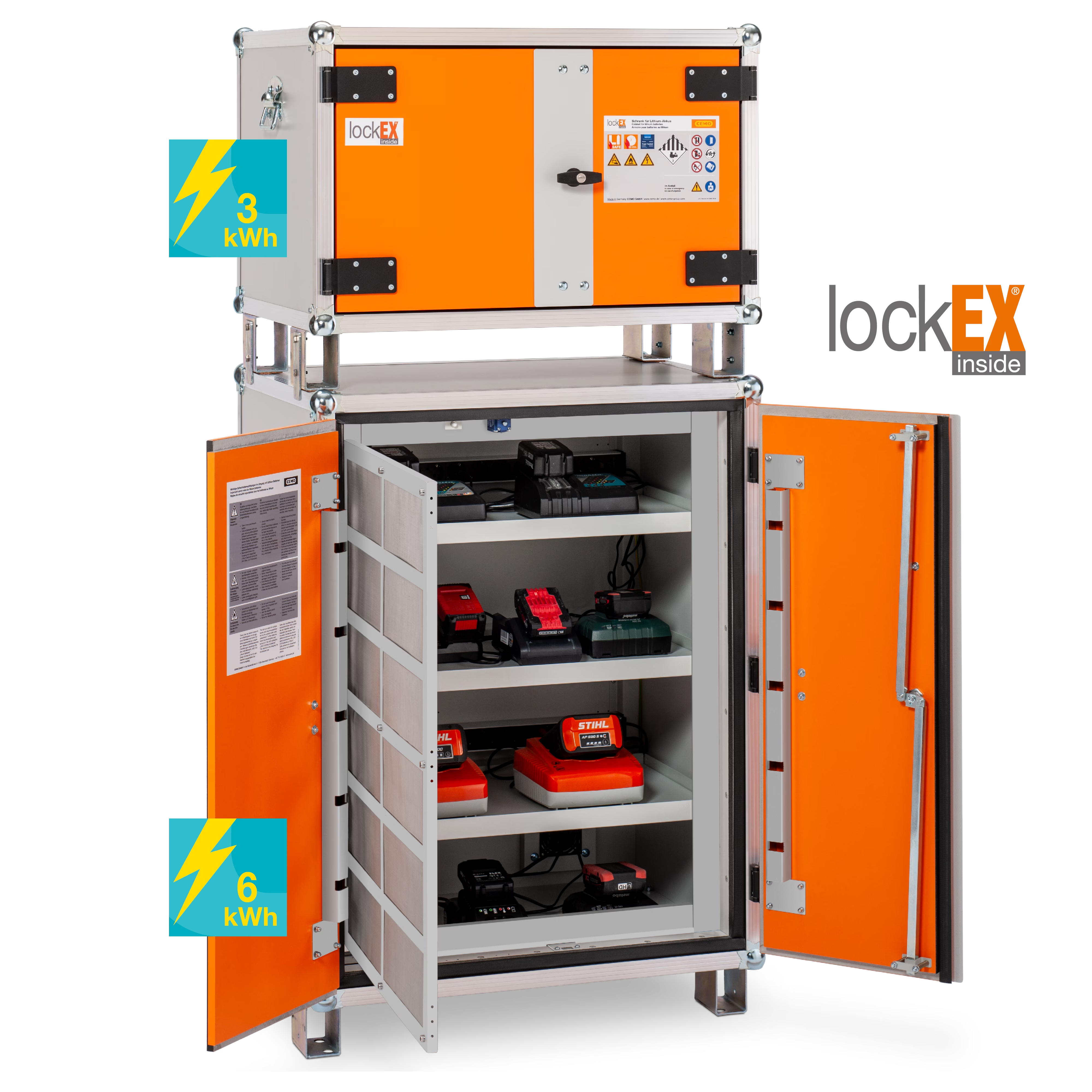
Performance without compromises
When it comes to security, only one thing matters: absolute reliability. lockEX 2.0 is a high-performance security solution, consistently designed for demanding applications.
Next Generation – Next Level Safety
lockEX 2.0 represents a new generation of sophisticated safety concepts. From cabinet size 8/10 (6 kWh) upwards, an innovative double door with a steel sheet spark guard provides additional protection.
Certified to the VDMA standard
Trust is based on proven quality. lockEX 2.0 battery charging cabinets are certified in accordance with the latest VDMA standard – clear evidence of state-of-the-art technology and high safety standards.
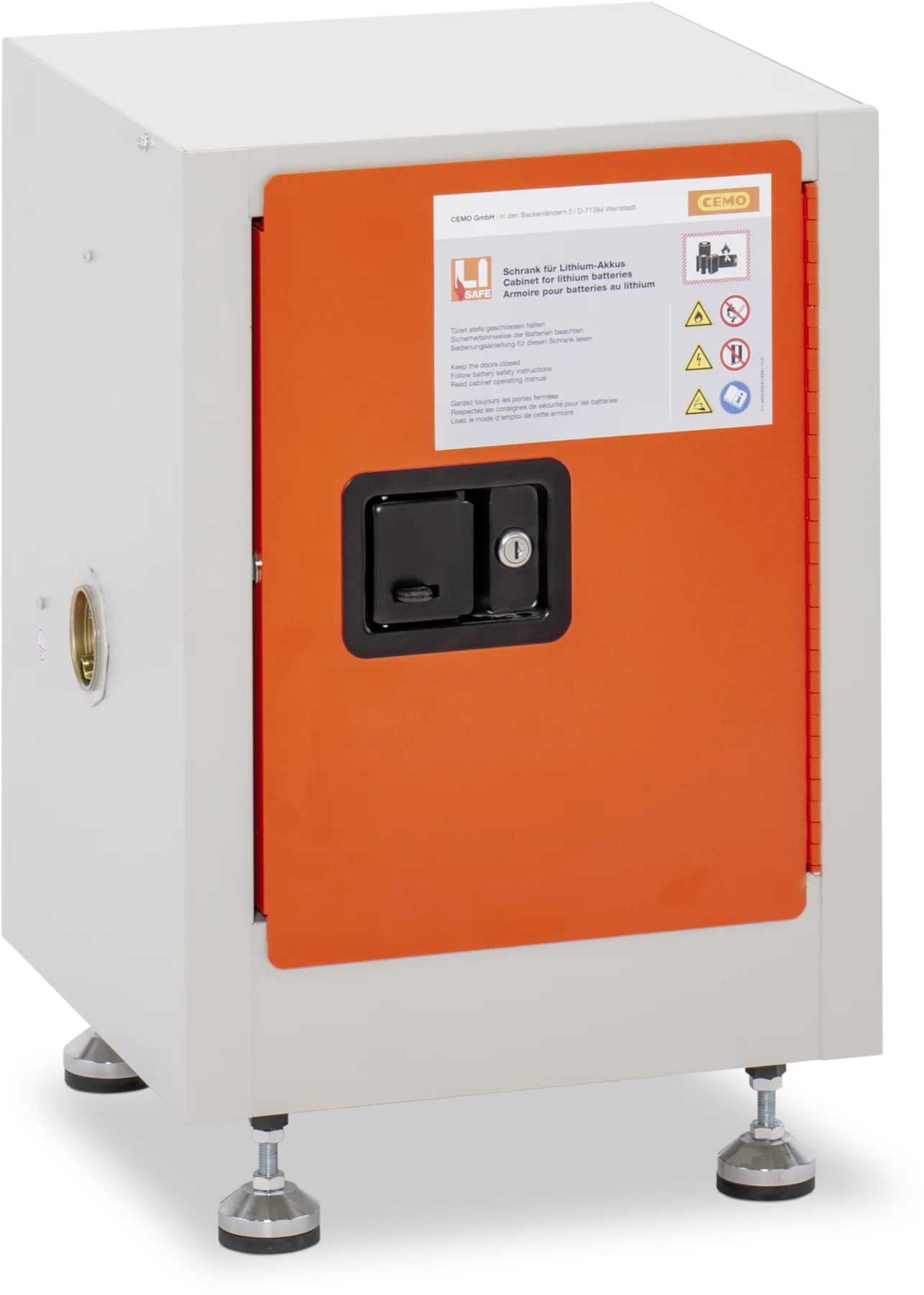
Products designed for the safe storage and charging of lithium-ion batteries
plus VAT
Freight costs: 132.00 €
Delivery time: approx. 4 weeks
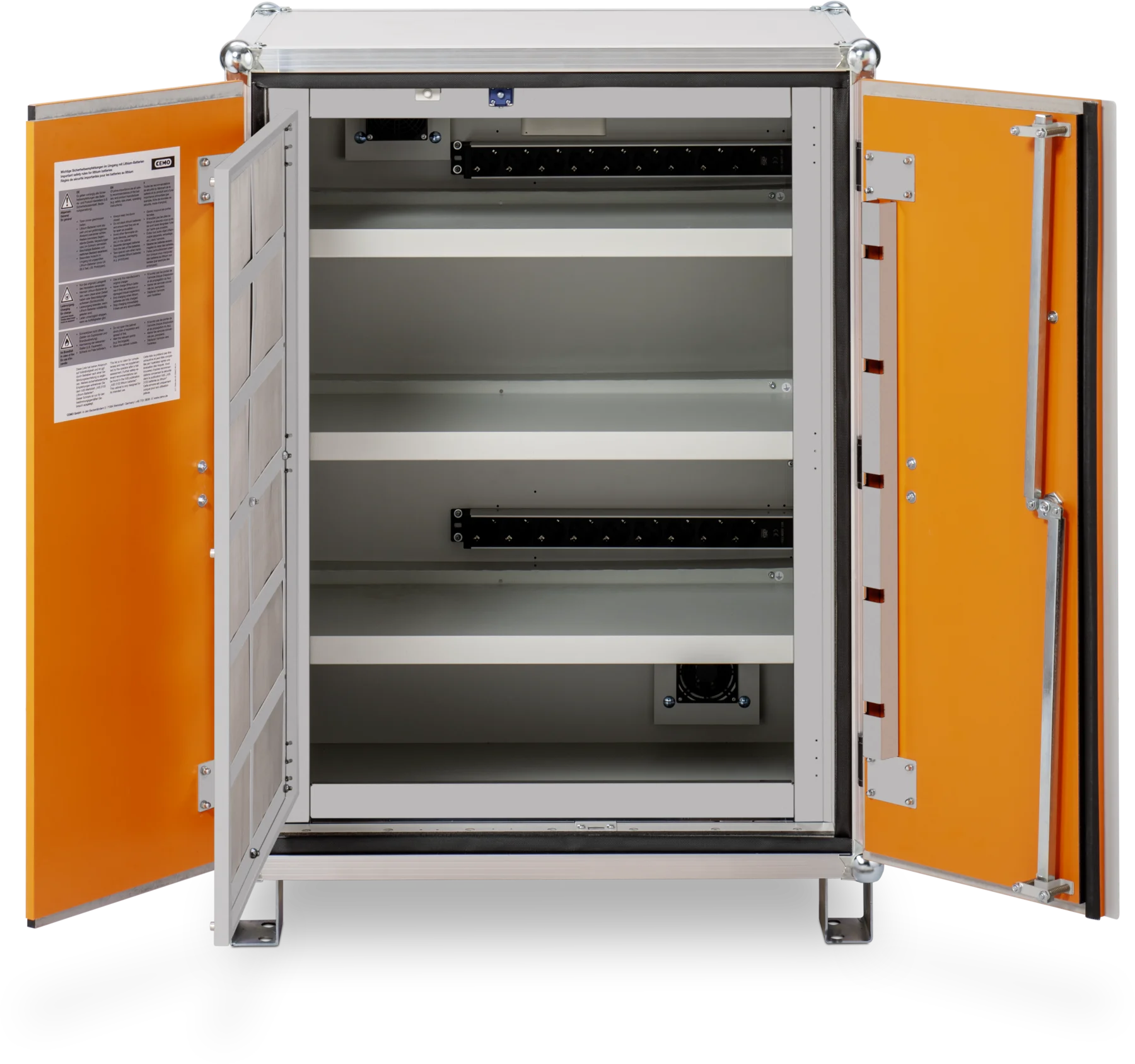
CEMO Battery charging cabinet Basic, 230 V, grey, double hinged doors, orange doors, with stacking feet
Art. no. 12114
plus VAT
Freight costs: 385.00 €
Delivery time: approx. 72 h
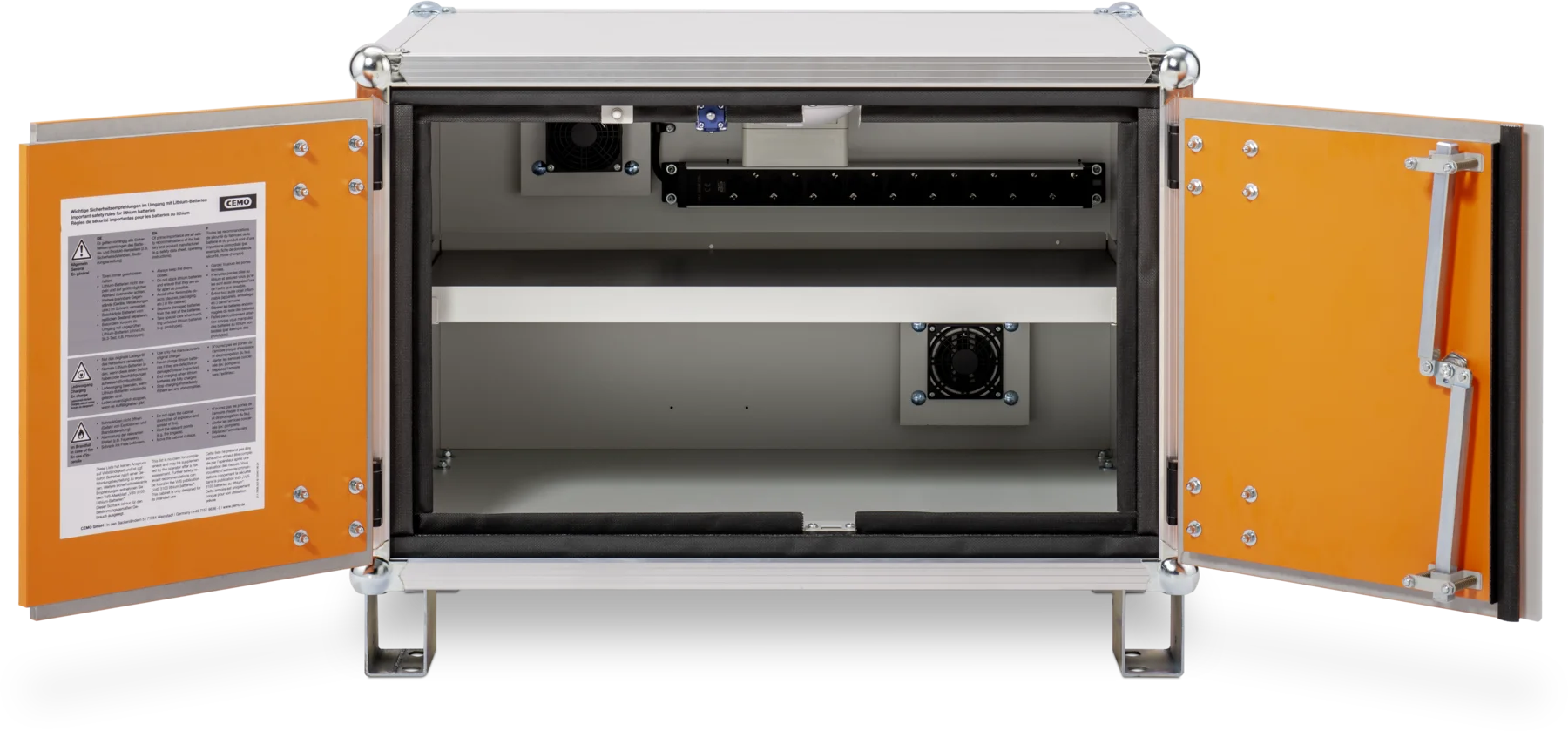
CEMO Battery charging cabinet Basic, 230 V, grey, double hinged doors, orange doors, with stacking feet
Art. no. 12109
plus VAT
Freight costs: 275.00 €
Delivery time: On request
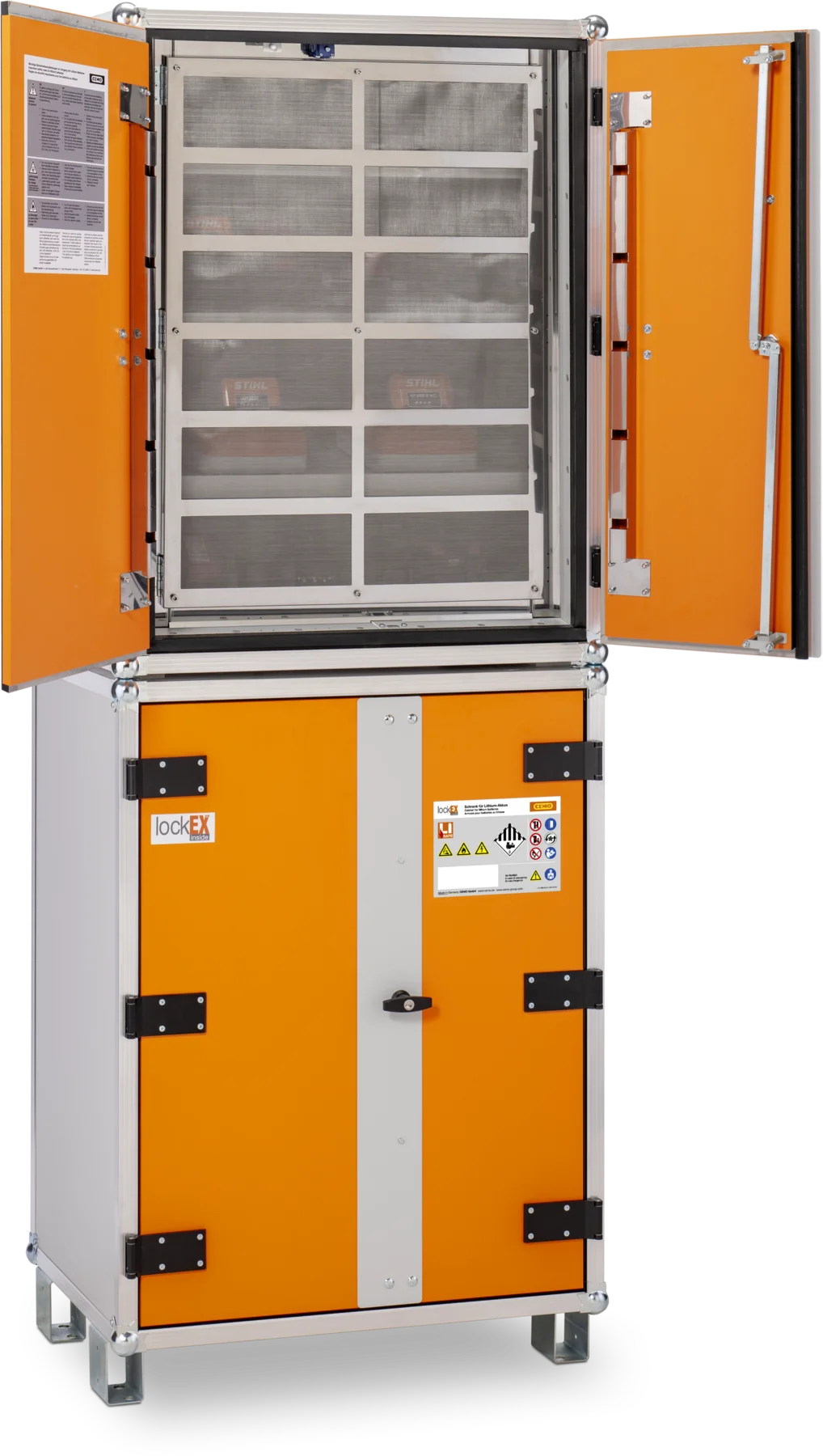
CEMO Battery charging cabinet Premium, 230 V, grey, double hinged doors, orange doors, feet
Art. no. 12050
plus VAT
Freight costs: On request
Delivery time: On request
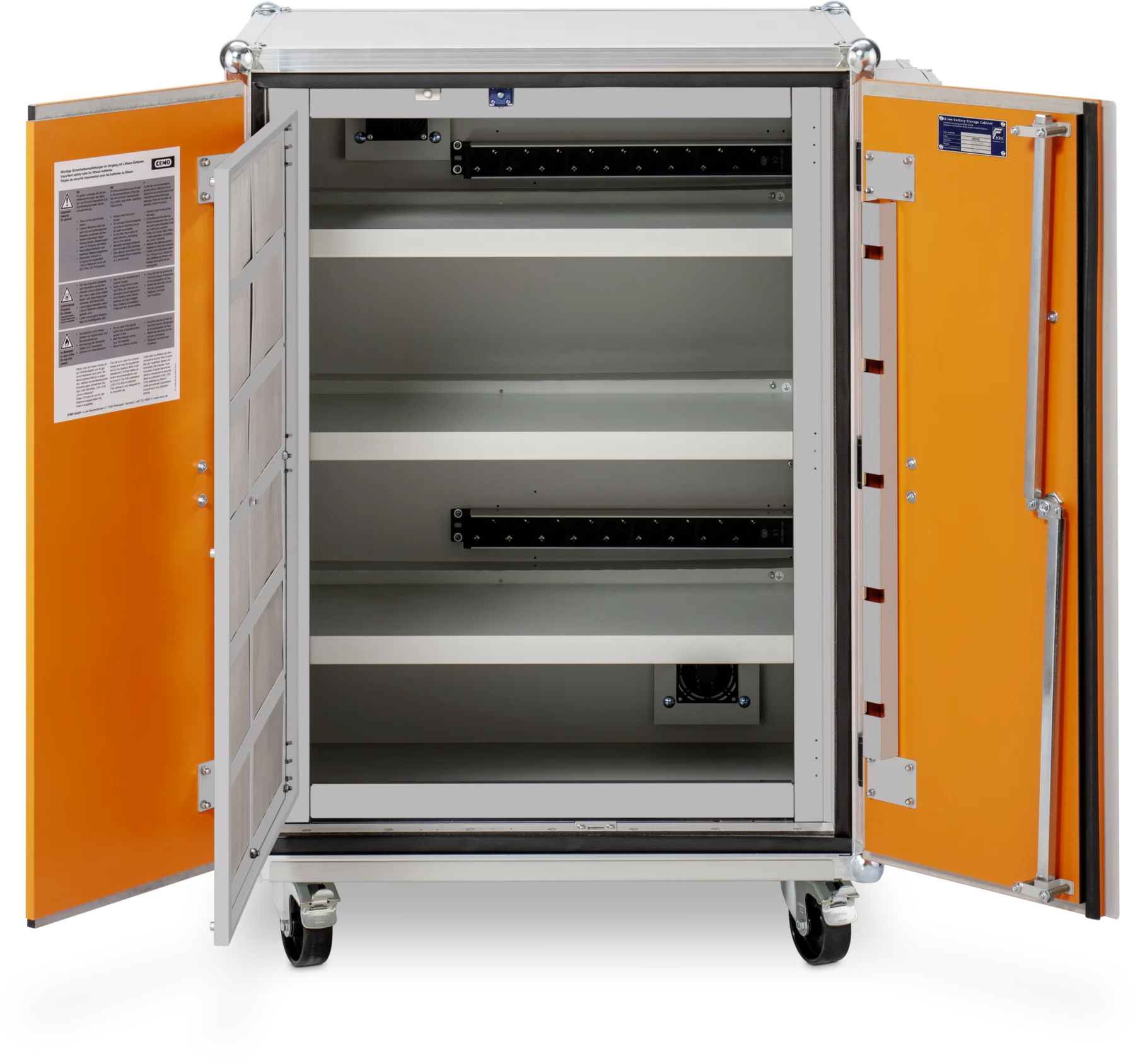
CEMO Battery charging cabinet Premium Plus, 230 V, grey, double hinged doors, orange doors, castors
Art. no. 12124
plus VAT
Freight costs: 0.00 €
Delivery time: On request
Frequently Asked Questions

Discover the right safety cabinets and hazardous materials storage solutions from CEMO, or get personalised advice.
The right solution for your battery safety
You are now familiar with the key requirements for storage, charging, transport and explosion protection. But which solution is right for your batteries, stock levels and operational requirements?